What It Takes to Turn Nutrition Knowledge Into a Professional Career
There is kind of a real difference between being knowledgeable about nutrition, and being qualified to practice as a nutrition professional. A lot of people build a pretty solid working understanding of food, macronutrients, dietary principles, through personal experience — like managing a health condition, supporting a family member, or just paying close attention to how what they eat connects to how they feel. This kind of knowledge is genuine, and often hard-won, you don’t just pick it up overnight. But it tends to live at a different level than the more structured, evidence based training that prepares someone to assess, advise, and support others in a professional role.This gap between personal familiarity and professional readiness is kind of more relevant now, because the need for trained nutrition practitioners keeps growing. Hospitals, rehabilitation centers, sports orgs and corporate wellness programs, plus community health initiatives, too, are all looking for people who can work inside clinical and institutional settings, not just talk in general terms about healthy eating. Knowing what it really takes to bridge that gap and what the formal nutrition education part actually involves, is useful for folks thinking about entering the field ,and for anyone trying to figure out what sets credentialed practitioners apart from everyday wellness communicators.
What Is a Diploma in Nutrition and Dietetics?
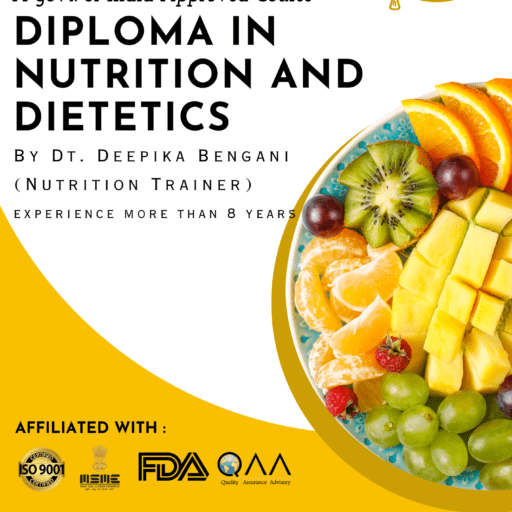
A diploma in nutrition and dietetics is a formal, structured educational qualification that gives foundational to intermediate level training in the science and practice of nutrition. It kind of sits between short-term certification courses and full undergraduate degree programs , so it offers a meaningful curriculum without the multi-year commitment of a bachelor’s degree .Diploma programs in this area usually touch on a variety of topics like human anatomy and physiology, the biochemistry behind macronutrients and micronutrients, principles of clinical nutrition, dietary assessment methods, therapeutic meal planning for common medical conditions, food science and safety, and a start to community or public health nutrition. A lot of programs also add a practical or internship component, where learners take what they studied and use it in supervised environments, like hospital dietary departments or community health organizations, and sometimes there’s a community outreach angle too.The outcome of completing such a program is not merely theoretical knowledge, but the applied ability to conduct dietary assessments, interpret nutritional requirements in clinical or community contexts, and develop meal plans suited to specific health conditions or population groups. This applied dimension is what distinguishes a diploma from informal self-study or general wellness education.Who Is This Typically For?
A diploma in nutrition and dietetics is relevant across a range of profiles and circumstances:- Recent graduates or school leavers: People who have done 12th standard or finished an undergraduate degree, and are trying to find a mapped trail into the health and wellness field, but not really wanting to lock into a full four-year degree plan right away.
- Working professionals in adjacent fields: People working in nursing, physiotherapy, pharmacy, fitness training, or health coaching, who want to officially increase their competence in nutrition — and add more credentials that widen their range, of practice.
- Individuals transitioning careers:People moving out of their unrelated professional background, who have noticed nutrition or wellness as a direction they actually want to enter , with proper, provable qualifications, not just vibes.
- Entrepreneurs in the wellness space: Those building nutrition consulting practices, wellness platforms, or community health initiatives who need a formal qualification to support credibility and, in some regions, legal compliance.
- Educators and community health workers: Those working in schools, NGOs, or public health settings who want structured knowledge to support nutrition-related outreach and guidance.
When Should Someone Consider This?
There are several practical scenarios in which pursuing a diploma in nutrition and dietetics represents a timely and well-reasoned decision:After completing 12th standard with a science background:For students who feel pulled toward health sciences yet are looking at other ways than the usual medicine or dentistry tracks, a diploma offers a more or less immediate and structured start into the field, with less time spent and a shorter commitment.
When professional practice is being limited by the absence of credentials:Fitness professionals and wellness practitioners who are already doing their thing in the field but then notice that clients, employers, or even institutional partners are asking for formal qualifications will, in a sense, get what they need from a diploma . It covers that credibility requirement pretty directly, without all the extra fuss.
When career redirection is being planned thoughtfully: Individuals in mid-career transitions who want to enter nutrition professionally benefit from a program that covers both the science and the applied skills, rather than only theoretical coursework or only practical exposure.
During a period where clinical exposure can be incorporated:Programs with internships are best taken on when the person can actually hold on to the supervised hours that are required. If you map out the diploma during a stretch with a bit more schedule wiggle room it tends to support finishing the whole program, start to finish.
How the Process Usually Works
Pursuing a diploma in nutrition and dietetics generally follows a structured sequence:- Eligibility verification:Most diploma programs ask for completion of 12th standard, usually with science subjects, and yeah there are often requirements that kinda overlap with it. In some cases, if candidates already have prior exposure to health, or even allied health education at an equivalent level, they can be considered.
- Program selection: Candidates look for a program, based on how deep the curriculum goes, how long it runs, the mode in general ( in-person, hybrid, or online ) and also if there is some practical training involved, or a clinical exposure type of component.
- Enrollment and induction: After acceptance, students go through the rather administrative enrollment part, and then start what is basically an orientation phase that kind of introduces the program structure, the faculty, and the learning expectations too.
- Core curriculum study: Students move through subjects sequentially or in modules — typically covering nutrition science, physiology, food safety, clinical dietetics, and community nutrition across the duration of the program.
- Practical or internship phase: A supervised placement inside a hospital dietary department, or even a community health organization , or a clinical nutrition setting lets students use the taught skills under professional guidance. It’s kind of necessary because this part helps build practical competence that actually shows up in real life . Without it, the learning stays more theoretical , and that doesn’t help much.
- Assessment and certification: Completion of coursework, practical hours, and assessments leads to the award of the diploma, which can then be used to support employment applications, professional registration, or further academic study.
Common Misconceptions or Mistakes
"A diploma is a lesser qualification than a degree and carries little professional weight." While a degree gives more depth, and is needed for some higher senior clinical roles , a diploma is also a recognized formal qualification that can offer enough preparation, for a broad set of entry level and mid level nutrition jobs. It sits separate from informal certifications and it comes with matching professional credibility.
"All nutrition diplomas are equivalent." Program quality , curriculum depth faculty expertise , the practical training elements and institutional accreditation can vary quite a bit, honestly. A diploma from a school that has structured clinical exposure and a full, well rounded curriculum is not the same thing as a shorter course with very little hands-on work content , it’s genuinely different in practice.
"Completing the program is sufficient to begin independent clinical practice." Depending on the jurisdiction, practicing as a dietitian may require registration with a professional body, completion of supervised clinical hours beyond the diploma, or additional credentialing. The diploma is a foundation, not always a standalone license to practice at all levels.
"Nutrition diplomas are only useful for those who want to open a private practice." Diploma holders work across hospitals, schools, food companies, NGOs, sports organizations, and public health programs. The career pathways are more varied than a single practice setting.
"The field is already saturated with nutrition professionals."Demand for qualified nutrition practitioners continues to climb, in step with rising rates of lifestyle-related disease , bigger corporate wellness programs, and more institutional recognition of preventive nutrition. Formal credentials help practitioners sort themselves into this demand, in a way that feels more strategic and steadier, overall.